Why Life Science Companies Should Invest in Professional Development of their Employees

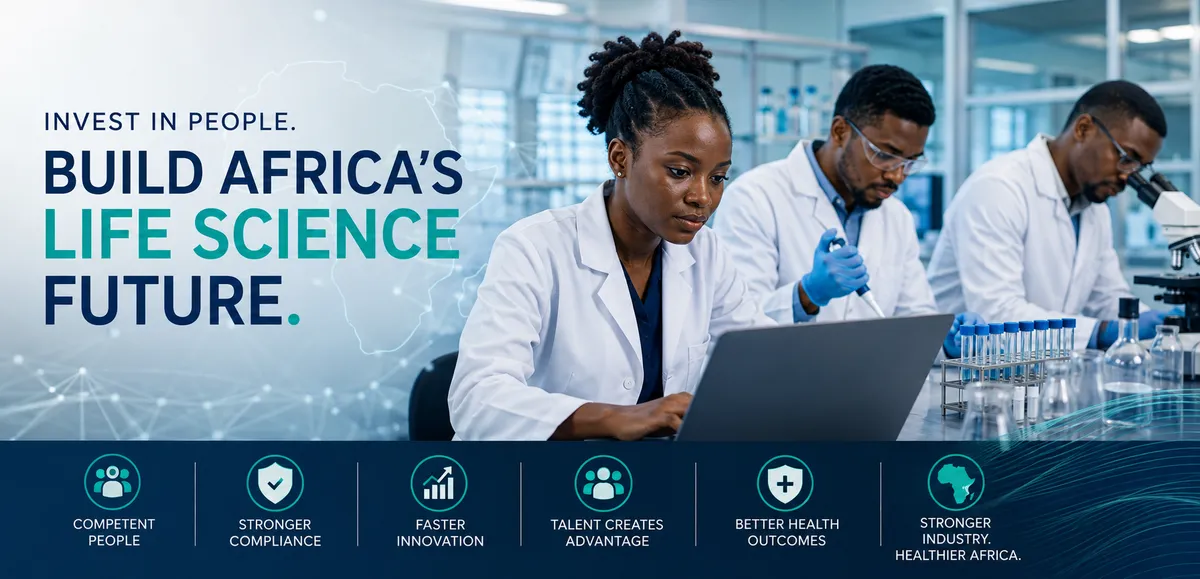
Africa’s life science industry is evolving rapidly, driven by scientific innovation, emerging technologies, and changing regulatory requirements. For companies to keep pace, they need more than new technologies—they need skilled, adaptable, and continuously developing talent. Investing in professional development strengthens technical capabilities, compliance, innovation, market confidence, and employee retention while positioning companies to influence industry trends and navigate regulatory change. In short, talent development is not a cost to contain; it is a strategic investment in sustainable growth and Africa’s life science future.
Life Science Companies Must Invest in their Employees Professional Development: This is Why.
The pace of growth and development in the life science industry in the last couple of years has accelerated. From CRISPR technology to MRA-based vaccines including advances in the time it takes to move a product from the bench to the lab as witnessed during COVID-19 where it took approx. 18 months to develop viable and effective vaccines for global use. These developments are enabled by human ingenuity, professional excellence and competence in executing their functions across the life science value chain. With the current adoption and postulation on the value of Artificial Intelligence (AI) in the life science industry, the pace of development will only be enhanced. In a competitive industry, the ability to position oneself optimally and strategically for these developments will be the determinant of success or not.
In addition to these advances in science and technology, there are tremendous changes in the regulatory and policy landscape with governments putting in place a myriad of safeguards to protect their citizens. This is evidenced with the emergence of regulatory guidelines for emergent technologies e.g., US FDA resources on Artificial Intelligence for Drug Development[1] and in Kenya, the Pharmacy and Poisons Board recently published Guideline on Regulation of Medical Device Software in Kenya (MDSW)[2]. From an African lens, continental development priorities with focus on the pharmaceutical industry from the Pharmaceutical Manufacturing Plan for Africa (PMPA) seeded ground for different initiatives which are fueling developments in the continent i.e., African Medicines Agency (AMA), Securing Continental Access to Lifesaving and Essential Medicines in Africa (SCALE), Africa Health Security Manufacturing Initiative (AHSMI) among others geared towards building resilience and health product security in the continent.
All these developments are predicated on the right talent being in place across research institutions, life science companies and regulatory agencies. Without the right talent, these capabilities and possibilities will be left to chance thus curtailing the potential for growth and development. How then can we move this conversation forward? How do we ensure we have the right talent in place in the industry?
From our work at with African Pharmaceutical Network (APN)[3] in professional development culminating in the establishment of the African Pharmaceutical and Biomedical Sciences Training Institute[4] – we have established key insights which are critical in understanding talent dynamics in the industry:
Conventionally, novel research and development all over the world is domiciled within academic institutions and industry. Those emerging from academic institutions only have a chance to be adopted for development and commercialization when and where there are existent industry-academic partnerships. Without these, research products remain theoretical postulations of what’s possible in science without room to test them for real world application. A missed opportunity and a great gap in the growth of Africa’s life science industry.
Industry relies on academic institutions to produce the right talent for their developmental priorities which means that the academic institutions must be attuned to the developments and realities of the industry. Failure in this leads to skills gaps in the industry which curtails growth capabilities and potential in the sector.
Regulators rely on scientific products and advances from industry to inform their regulatory functions. Where development lags in the industry, regulators are incapacitated. However, when the industry has the right skills with no latitude to engage with and build capacity for regulatory agencies especially in emergent technologies, the risk is delayed market access which has both commercial and public health implications.
To close these gaps, we believe the industry has a catalytic function which calls on them to invest in the professional development of their talent.
First, by investing in the development of their employees they unlock their full potential to deliver value for their business processes. This ranges from technical capabilities, operational nuances leading to efficiencies and leadership capabilities shaping industries. These are harnessed in internal commercial success metrics when novel products are developed, product launches are expedited based on employee understanding of novel regulatory pathways & approaches, market confidence in company products based on strong quality and pharmacovigilance systems which are reassuring for stakeholders, timely delivery of supplies based on improved supply chain systems and reimbursement guarantees guided by comprehensive value-dossiers.
Second, empowered and engaged employees shape industry trends and developmental priorities creating an impetus for industry growth. Every company with industry leaders and shapers always enjoys the benefits of being in the know-when and where new trends are emerging if not shaping them. This grants companies access to market intelligence to capitalize on in their developmental aspirations.
Third, when regulators rely on insights from industry experts and leaders, companies who nurture these capabilities have an upper hand as they build key relationship to help with guidance when and where they need it but most importantly can negotiate from a point of trust/confidence with regulators when emerging requirements are punitive to the industry. Such benefits often accrue to the entire industry but as an industry leader, companies enjoy the benefits by being part of the process thus are better positioned to comply with and fulfill these requirements for faster market entry when and where necessary assuming they had products in these therapeutic areas or categories.
Fourth, companies that invest in their employees reduce their compliance costs with fewer mistakes, fewer market actions if at all and most importantly enhanced market confidence. From our experience working with businesses, when companies have a good reputation in the market, they capture market premium in terms of physicians prescribing their products with confidence, patients requesting for their products outrightly in pharmacies and even willingness to pay more for their products in the presence of cheaper alternatives.
Finally, with empowered and competent employees, companies have engaged talent with low attrition rates thus reducing HR costs, improved quality of talent pipeline as ambitious professionals aspire to join the company based on its reputation. This ensures the company always has a talent-based competitive advantage over competitors in the market.
In Africa’s life science industry, the organizations that invest in people will be better positioned to meet regulatory expectations, scale responsibly, compete sustainably, and deliver quality health products to the patients who need them. Professional development is not a cost to be contained; it is a strategic investment in the future of the industry with guaranteed returns – maybe slow to materialize but guaranteed to pay off in the end.
Artificial Intelligence for Drug Development: https://www.fda.gov/about-fda/center-drug-evaluation-and-research-cder/artificial-intelligence-drug-development ↑
Guideline on Regulation of Medical Device Software in Kenya (MDSW): https://web.pharmacyboardkenya.org/download/guideline-on-regulation-of-medical-device-software-in-kenya-mdsw/ ↑
African Pharmaceutical Network: https://africanpharmanetwork.net/ ↑
African Pharmaceutical and Biomedical Sciences Training Institute: https://www.linkedin.com/company/the-pharmacy-academy/ ↑