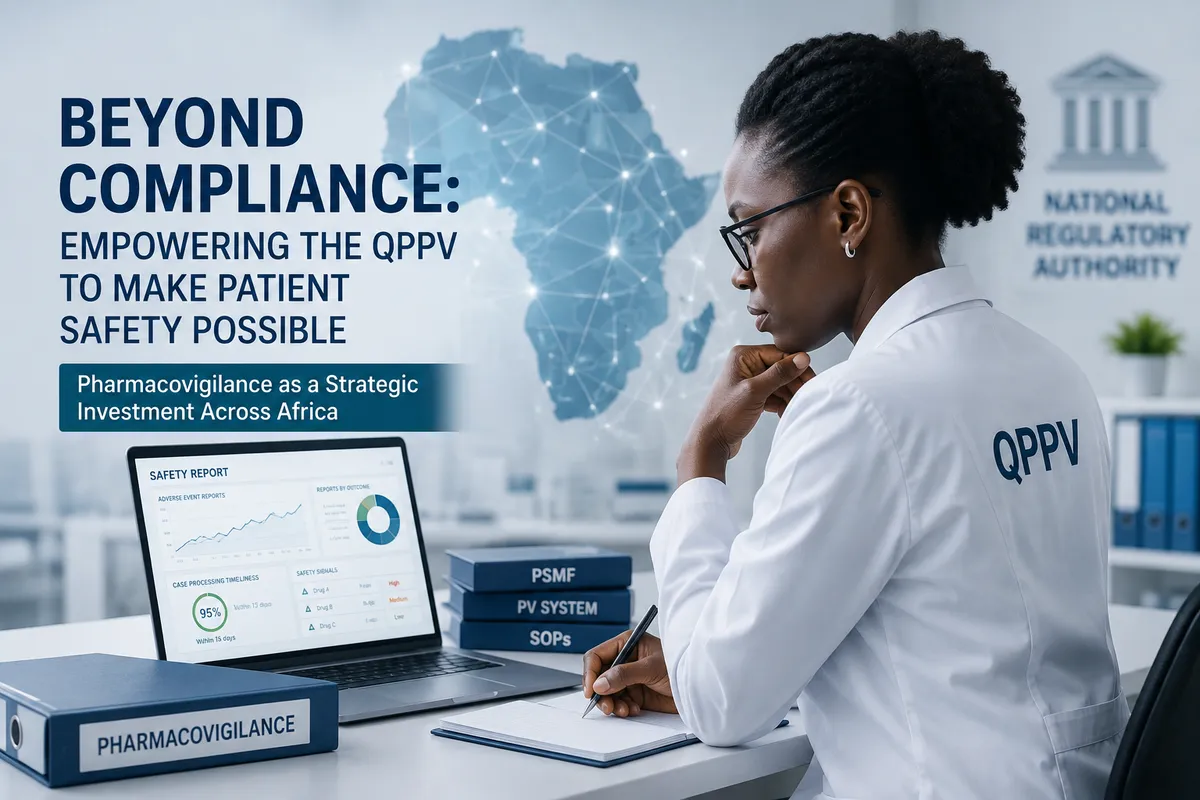
QPPV in Africa: From Regulatory Compliance to Strategic Patient-Safety Leadership

Across Africa, pharmacovigilance is evolving from a regulatory requirement into a strategic pillar of patient safety and responsible pharmaceutical market participation. At the center of this shift is the Qualified Person for Pharmacovigilance (QPPV)—not simply as a compliance appointment, but as an empowered leader responsible for ensuring safety information is captured, assessed and acted upon. For Marketing Authorization Holders, building the authority, systems, information flows and resources needed to support the QPPV can strengthen regulatory readiness, protect patients and build trust across increasingly connected African markets.
Across Africa, pharmacovigilance is moving from being a regulatory expectation to becoming a visible marker of responsible market participation. National Regulatory Authorities (NRAs) are strengthening post-marketing surveillance, requiring Marketing Authorization Holders (MAHs) to establish pharmacovigilance systems, maintain Pharmacovigilance System Master Files (PSMFs) and appoint Qualified Persons for Pharmacovigilance (QPPVs). Kenya’s Pharmacy and Poisons Board (PPB), for example, has issued specific guidance requiring MAHs to appoint a QPPV, maintain systems for collecting, collating and evaluating safety information, and remain inspection-ready. At continental level, the African Medicines Agency (AMA) is also taking shape as a mechanism to strengthen regulatory capacity, harmonization and patient safety across the continent.
This shift matters. Africa’s pharmaceutical landscape is expanding rapidly, with increasing local manufacturing ambitions, regional regulatory harmonization, growing digital health systems, cross-border supply chains and continued concern about substandard and falsified medical products. In such an environment, appointing a QPPV should not be treated as a paperwork exercise undertaken to satisfy a deadline. It should be understood as a strategic patient-safety investment and a governance decision that determines how quickly a company can identify risk, act on data and sustain trust with regulators, healthcare professionals and patients.
The distinction between compliance and capability is therefore critical. Compliance asks whether an MAH has appointed a person who meets the regulator’s minimum requirements. Capability asks whether that person can actually oversee a functioning pharmacovigilance system. Does the QPPV receive adverse event reports in time? Do they have access to product quality complaints, medical information enquiries, market research outputs, patient support program data and distributor feedback? Are case processing timelines monitored? Is there a documented escalation pathway when a safety concern emerges? Can the QPPV challenge commercial pressure, request corrective action or delay a decision where the benefit-risk profile demands it?
A QPPV without authority, systems and resources is a symbol of compliance, not a guardian of safety. To move beyond the symbol, companies should deliberately design the QPPV role around four considerations.
Authority: The QPPV must have direct access to senior management and the ability to escalate urgent safety issues without bureaucratic delay.
Information Flow: Every function that may receive safety information, including sales, medical, quality, regulatory, customer service and third-party distributors, must understand what to report, to whom and within what timelines.
Infrastructure: the company needs SOPs, trained personnel, validated tracking tools, literature monitoring arrangements, quality management processes, CAPA management and business-continuity plans, including a trained deputy or backup QPPV.
Oversight of outsourced activities: where PV tasks are contracted out, the MAH remains accountable and the QPPV must be able to audit, monitor and challenge vendor performance.
For MAHs operating in several African markets, the case is even stronger. Requirements may differ between countries, but patient exposure, safety signals and reputational risk do not respect borders. A serious adverse event reported in one market may have implications for labelling, risk minimization, healthcare professional communication or supply decisions elsewhere. An empowered QPPV helps connect local obligations with regional and global safety governance, ensuring that African data is not lost, delayed or undervalued in global benefit-risk assessment. This is particularly important because spontaneous reporting remains underdeveloped in many settings, and every quality report, adverse event and patient complaint may carry important signal value.
There is also a business case. A mature PV system protects patients, but it also protects the company. It supports inspection readiness, reduces avoidable regulatory findings, strengthens product stewardship and builds credibility with regulators. It enables evidence-based decisions on product continuation, labelling updates, targeted training, risk minimization and market access. It can also prevent small weaknesses from becoming serious regulatory, legal or reputational failures. In a continent where trust in medicines is inseparable from trust in supply chains and regulatory systems, pharmacovigilance is not a back-office function; it is part of the social license to operate.
The practical question for every MAH should therefore change from, “Have we appointed a QPPV?” to “Have we built a system that enables the QPPV to protect patients and advise the business with confidence?” The answer should be tested through clear reporting lines, adequate budget, documented processes, training records, performance metrics, vendor oversight, audit readiness and evidence that safety information is acted upon. A QPPV should be involved before problems arise, not only after a regulator asks questions.
Ultimately, Africa’s evolving regulatory environment offers MAHs an opportunity to move beyond minimum compliance and build pharmacovigilance systems that are proactive, resilient and data-informed. The companies that will be best positioned are those that see the QPPV not as a regulatory formality, but as a central safety leader: empowered, resourced and trusted to ensure that every medicine placed on the market is continuously monitored in the real world. In that sense, the QPPV is not merely evidence that a company has met a requirement. The QPPV is a measure of whether the company is truly prepared to make patient safety possible.