Intellectual Property as a Growth Strategy for Africa’s Life Sciences Industry

Intellectual property is a critical but often overlooked driver of growth in Africa's life sciences industry. Beyond patents, effective IP management helps manufacturers protect innovation, strengthen competitiveness, attract investment, and maximize the value of their products, technologies, and brands. As Africa expands local pharmaceutical manufacturing, building strong IP capabilities will be essential for sustainable growth and innovation.
Across Africa, the debate on local pharmaceutical and life sciences manufacturing is often framed around factories, financing, regulation and market access. These are essential. But one strategic asset is still underused: intellectual property. For African manufacturers, IP should not be treated only as a legal formality or as a defensive tool used by large multinational companies. Properly understood, IP is a practical business system for identifying what a company knows, protecting what differentiates it, licensing what it cannot yet build alone, and converting innovation into commercial value.
In the life sciences sector, patents remain the most visible form of IP because they can protect new molecules, formulations, manufacturing processes, diagnostics, vaccines, biological platforms and delivery technologies. Yet patents are only one part of the story. Trademarks protect product and company brands. Trade secrets protect manufacturing know-how, quality systems, supplier intelligence and process improvements. Copyright protects technical manuals, training materials, databases and software. Industrial designs may protect device features and packaging. Contracts govern how all these assets move between manufacturers, distributors, research institutions, regulators, technology partners and investors.
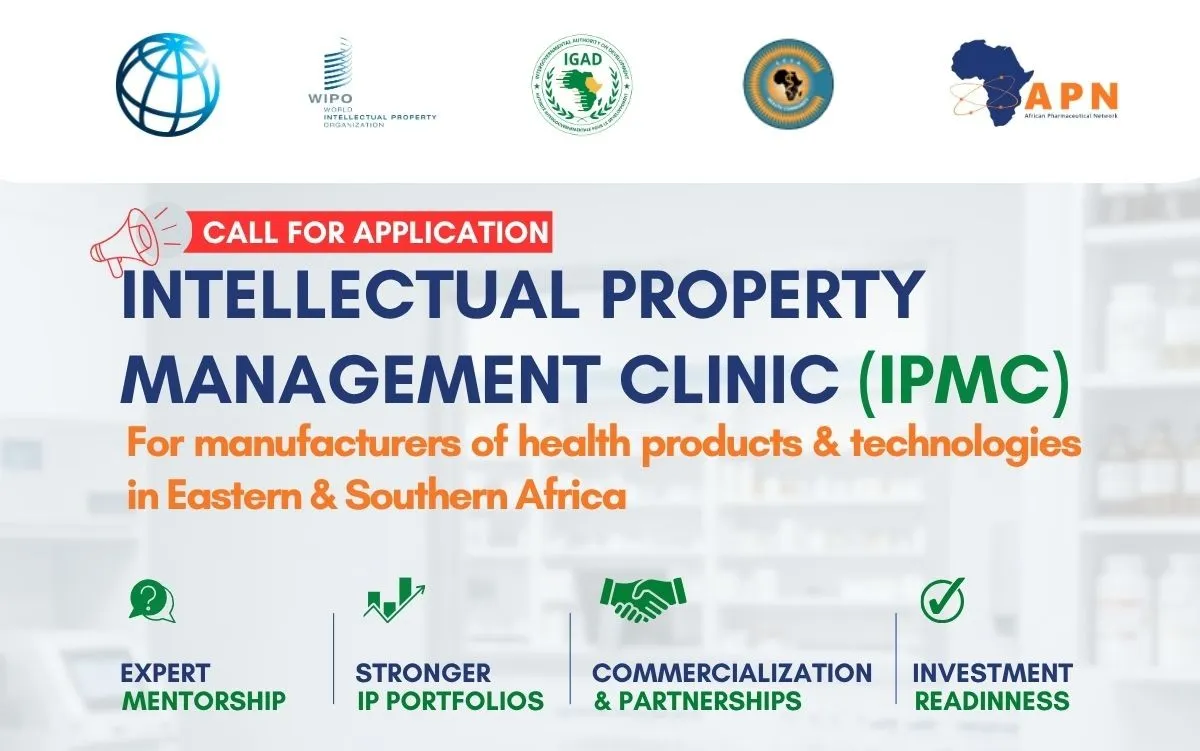
This matters because Africa’s life sciences industry is no longer operating only as a low-margin generic supply base. The continent is trying to build pharmaceutical security, vaccine manufacturing capacity, diagnostics capability, biomanufacturing skills and regional supply resilience. The African Union has called for stronger local production capacity, including vaccine manufacturing, after COVID-19 exposed the risks of excessive dependence on external supply. This is the foundation upon which the Inter-Governmental Agency for Development (IGAD), African Pharmaceutical Network (APN) and World Intellectual Property Organization (WIPO) with support from the World Bank is organizing an Intellectual Property Management Clinic (IPMC) targeting 20 manufacturers across the Eastern, Central and Southern Africa region. These initiatives reflect a simple reality: manufacturing capacity without IP capability leaves firms dependent on other people’s brands, technologies and terms.
Limits of the Traditional Generic Model
The generic model remains important and commercially valid. It expands access, drives down prices and allows manufacturers to serve high-volume public and private markets. However, if a company competes only on price, without building protected brands, proprietary processes, regulatory dossiers, quality systems or technology partnerships, it becomes vulnerable. Margins are squeezed, distributors become more powerful, product identity becomes weak, and the enterprise may be difficult to value when founders want to raise capital, form joint ventures or exit.
The risk is especially high where companies rely on informal commercial arrangements. A manufacturer may assume that a product name, registration dossier, packaging design, regulatory approval pathway or distributor relationship belongs to the business, only to discover later that ownership was never clearly documented. This can turn a commercial partnership into a dispute over market authorization, product registration, brand ownership or distribution rights. The Kenyan dispute involving Galaxy Pharmaceuticals, Prism Life Sciences and the Pharmacy and Poisons Board illustrate this risk. Public court records show that Galaxy Pharmaceuticals challenged regulatory action concerning the intended cancellation of registrations for 40 health products, while reporting on the dispute described underlying disagreements around product ownership, marketing authorizations and intellectual property. Whatever the final legal position in the related proceedings, the lesson for manufacturers is clear: IP ownership, regulatory rights, local technical representative arrangements, trademarks and distribution contracts must be structured before a dispute arises, not after the market has already been built.
IP as a Value-Capture System, not just a Patent Filing
For African life sciences companies, IP should begin with an internal audit: what does the company own? what does it use under license? what does it need to protect? and what can be commercialized? Many local manufacturers have valuable assets that are not visible on the balance sheet. These include formulation know-how, stability data, validated manufacturing processes, quality assurance systems, supplier networks, regulatory dossiers, brand reputation, training systems and market intelligence. When these assets are not documented, protected or contractually controlled, they cannot be properly valued.
This has practical consequences. A business with protected brands, defensible know-how, clean chain-of-title documentation, technology licenses and registered product assets is more attractive to investors and strategic partners than a company that merely owns a factory and sells unprotected commodities. IP allows founders to demonstrate that the value of the company is not only in machinery or stock, but also in repeatable systems, market position and legally defensible intangible assets.
IP and Technology Transfer
Technology transfer is also an IP issue. When a company receives a process, platform, cell line, formulation, manufacturing protocol, device design or analytical method, it must understand the rights attached to that knowledge. Can it manufacture only for the local market, or for export? Can it improve the technology? Who owns improvements? Can the recipient sublicense? What data must be shared? What happens if the technology becomes relevant to another disease area? These questions determine whether technology transfer creates dependency or genuine industrial capability.
The South African mRNA technology transfer hub is a strong example. The programme, located at Afrigen in Cape Town and involving Afrigen, Biovac and the South African Medical Research Council (SAMRC), was established to build sustainable mRNA production capacity in low- and middle-income countries. WHO and the Medicines Patent Pool describe the model as a hub that provides know-how, technology and training to partners, with intellectual property and legal frameworks forming part of the technology transfer architecture. Afrigen has also described work on mRNA vaccine products for diseases such as RSV, Rift Valley fever, gonorrhoea, HIV, mpox and tuberculosis. This shows how IP can support a platform approach: once capability is built, it can be adapted to regional health priorities rather than remaining limited to one product.
From Compliance to Competitiveness
Too often, African manufacturers approach IP only when they are registering a company name, filing a trademark or responding to a dispute. That is too late. IP should sit inside corporate strategy, product development, regulatory planning and commercial contracting. Before launching a product, a company should know whether the brand is registrable, whether the product name conflicts with existing marks, whether the formulation or process is patent-encumbered, whether freedom-to-operate analysis is needed, and whether distributor agreements preserve the manufacturer’s rights in regulatory dossiers and market authorizations.
The same discipline is needed in research collaborations. Universities, public research institutes, start-ups and manufacturers should agree early on how background IP, foreground IP, data, biological materials, publications, improvements and commercial rights will be handled. Without this discipline, promising African science may fail to translate into products, or may be commercialized elsewhere without fair value returning to the local innovators and institutions that helped create it.
What Should Manufacturers Do?
African life sciences manufacturers should treat IP management as a board-level capability. The first step is to map all intangible assets: trademarks, product names, regulatory dossiers, process know-how, technical documentation, software, databases, packaging designs, licenses and confidential information. The second is to clarify ownership through employment contracts, consultant agreements, manufacturing agreements, distribution contracts, research collaboration agreements and technology transfer arrangements. The third is to protect priority assets through registration, confidentiality controls, licensing structures and freedom-to-operate reviews. The fourth is to build an IP commercialization plan that links protected assets to financing, partnerships, export markets, valuation and growth.
This is why the proposed Intellectual Property Management Clinic is timely. By pairing manufacturers with IP experts and focusing on IP understanding, development, protection and value capture, the clinic can help firms move from reactive protection to strategic management. The opportunity is not merely to file more trademarks or patents. It is to help African manufacturers build companies whose technical, commercial and regulatory assets are visible, defensible and valuable.
Conclusion
The case for IP in Africa’s life sciences industry is not abstract. It is a case for stronger businesses, safer partnerships, better technology transfer, more credible valuations, clearer market ownership and greater health security. Africa’s manufacturers should continue to build factories and pursue regulatory excellence. But they must also build IP systems. Without them, value will leak out of the enterprise. With them, African life sciences companies can protect what they create, negotiate from a position of strength and participate more meaningfully in the next generation of health innovation.