Before AI Can Power Africa’s Life Sciences...

AI has huge potential to transform Africa’s life-sciences industry, but AI itself isn’t the foundation. It depends on the infrastructure underneath it: quality, connected data; computing power and digital infrastructure; skilled people; trust and governance; and investment. Across pharmacovigilance, supply chains, clinical research and regulatory affairs, AI can only work as well as the systems feeding it. Fragmented data, poor interoperability, weak digital infrastructure and unclear governance can limit even the smartest AI tools. Africa’s AI opportunity in life sciences therefore isn’t just about building smarter applications. It’s about building the foundations that make those applications reliable, scalable and responsible. The model gets attention. Infrastructure does the work.
There is a lot happening around AI in Africa right now.
AI in diagnostics. AI in drug discovery. AI in pharmacovigilance. AI-powered supply chain forecasting. AI for regulatory intelligence. AI for clinical research.
For Africa's life science industry, the possibilities are not difficult to imagine.
And according to the African Development Bank's 2025 report on Africa's AI productivity potential, health and life sciences are expected to account for 7% of Africa's potential AI productivity gains by 2035, making the sector one of the five priority industries expected to benefit most from the technology.¹
That's a big opportunity.
But before AI can power the growth of Africa's life science industry, something else has to power the AI.
And that's where the conversation gets less exciting.
Because when we talk about AI in life sciences, we usually talk about what it can do.
Can it identify a safety signal faster? Can it predict medicine shortages?
Can it help discover a drug? Can it make regulatory processes more efficient?
Fair questions.
But underneath every one of them sits another question:
What does the AI need before it can do any of that?
The African Development Bank has a fairly straightforward answer. For Africa to capture its AI opportunity, it says five things need to work together: data, compute, skills, trust and capital.1
Notice what isn't on the list.
A chatbot.
That's because AI is not the foundation.
It sits on one.
Take pharmacovigilance.
We keep talking about AI's potential to process thousands of adverse-event reports, detect patterns and identify potential safety signals earlier than a human analyst working through the same information manually.
Great.
But where is the safety data?
Is it digital?
Is it structured?
Is it complete?
Can systems across manufacturers, healthcare facilities, regulators and other reporting points actually exchange that information?
Or is the AI being asked to find a signal in data that is scattered across spreadsheets, PDFs, separate databases and systems that have never met each other?
That's not really an AI problem.
It's a data infrastructure problem.
And WHO is already telling us that Africa has one.
The World Health Organization's assessment of health information systems in the African Region found an overall system maturity of 58% in 2024, placing the region in the early maturity category. WHO specifically identifies fragmented data systems, lack of interoperability and weak data governance as major reasons health data remains underused.2
Now put that next to the AI conversation.
AI is very good at finding patterns.
But patterns require data.
And useful patterns require data that is actually useful.
You cannot build an intelligent pharmacovigilance system on safety information that cannot talk to itself.
The same problem follows us into pharmaceutical supply chains.
AI can theoretically forecast demand, anticipate stockouts, and optimize inventory.
But forecasting depends on knowing what happened before.
What was ordered?
What arrived?
What was delayed?
What expired?
What was dispensed?
What is currently sitting somewhere in a warehouse?
If procurement has one dataset, inventory has another, distribution has another, and consumption data is either delayed or missing altogether, the problem isn't that the algorithm needs to be smarter.
The system needs to know what is going on first.
Then there is regulatory intelligence.
Imagine an AI tool helping a pharmaceutical company navigate regulatory requirements across African markets.
Sounds useful.
It probably is.
But it needs access to regulations, guidelines, product classifications and regulatory decisions that are current, structured and searchable.
An AI cannot reliably provide regulatory intelligence if the intelligence it needs is buried in documents it cannot access, written in formats it cannot process or simply not available digitally.
Again: before regulatory AI, there has to be regulatory data.
This is where the African Union's Continental AI Strategy becomes particularly relevant.
The strategy says Africa needs sustained investment in reliable electricity, broadband connectivity, data infrastructure, cloud and data-center capacity, computing power and large sets of quality data.3
That list matters because life-science AI does not operate in some separate universe.
The AI helping a pharmaceutical company analyze safety data still needs computing power.
The system processing clinical information still needs secure data infrastructure.
The supply-chain model still needs connectivity.
The hospital or laboratory feeding information into the system still needs reliable digital systems.
And, yes, the whole thing still needs electricity.
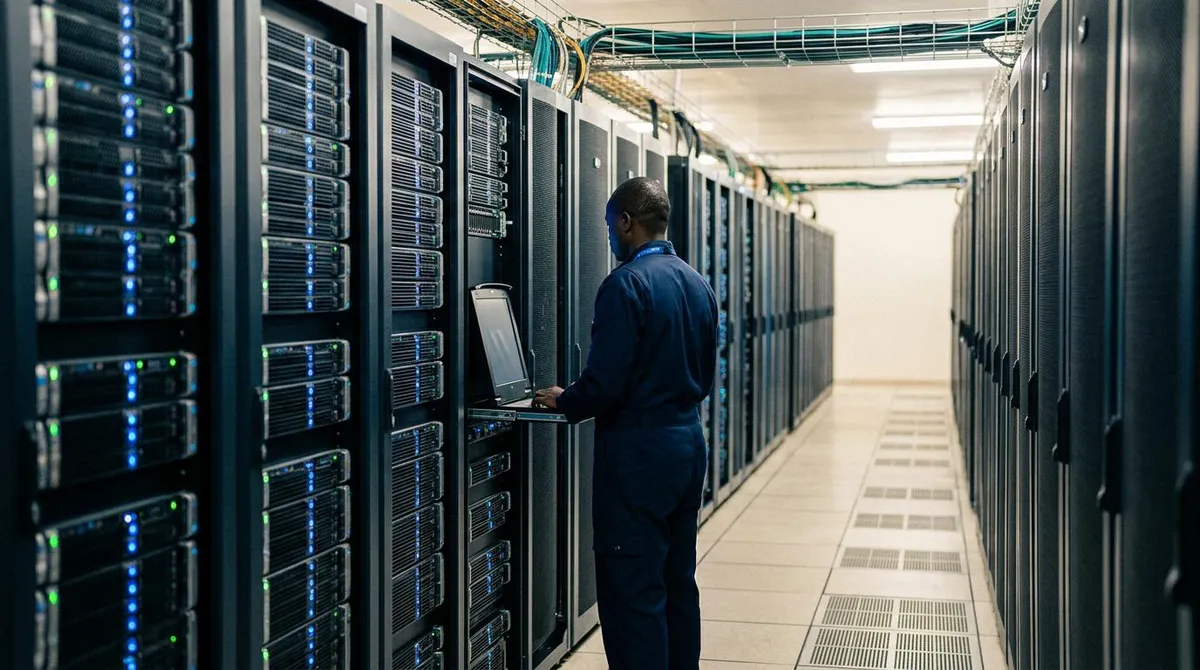
This is the part of AI we don't see.
The model gets the attention.
The infrastructure does the work.
And perhaps Africa's life science industry has an even bigger reason to care about this than most.
Life-science data is sensitive.
Clinical data is sensitive.
Patient data is sensitive.
Safety data is sensitive.
You cannot simply collect everything, upload it somewhere and call it an AI strategy.
There have to be rules.
Who owns the data?
Who can access it?
Where is it stored?
Can it cross borders?
Who is accountable when it is misused?
The African Development Bank's AI productivity report calls this trust—one of the five foundations required for Africa's AI growth. That trust is built through governance, regulation and systems capable of protecting people while still allowing responsible innovation.
And that might be the trickiest infrastructure of all.
Because a data center can be built.
A server can be bought.
Computing capacity can be expanded.
But trust takes longer.
People need to know that their health information will not simply disappear into an AI system they do not understand.
Companies need clarity on what they can and cannot do with sensitive data.
Researchers need access to information without compromising the people behind it.
Regulators need frameworks capable of protecting the public without treating every new technology like a problem waiting to happen.
So when we ask what infrastructure Africa needs to power AI in life sciences, the answer is bigger than a few more data centers.
It starts with life-science data that is actually usable.
Clinical data.
Safety data.
Supply-chain data.
Regulatory data.
Research data.
Not just more of it.
Better data.
Structured data.
Interoperable data.
Governed data.
Then comes the ability to do something with it.
Computing infrastructure.
Cloud capacity.
Data centers.
Reliable power.
Connectivity.
And then the people.
Because someone still needs to understand the science, the pharmaceutical industry, the data and the technology well enough to build these systems properly.
The African Development Bank estimates that Africa could generate up to $1 trillion in additional GDP by 2035 through inclusive AI deployment.⁵ Health and life sciences are among the sectors expected to capture a meaningful share of that opportunity. But the same report makes something else clear: that growth is conditional.
It depends on the foundations.
Data. Compute. Skills. Trust. Capital.
That is probably where the conversation about AI and Africa's life science industry needs to move next.
Not away from the exciting applications.
Towards what will make them possible.
Because an AI system that can identify a drug-safety signal is exciting.
The infrastructure that gives it reliable safety data is not.
An AI system that predicts medicine shortages is exciting.
The infrastructure that gives it real-time information about medicines moving through the supply chain is not.
An AI system that helps navigate regulatory requirements is exciting.
The work required to digitize, structure and maintain the regulatory information behind it is not.
But without the second thing, the first thing doesn't happen.
Or at least, not properly.
At African Pharmaceutical Network, we spend a lot of time thinking about what the next frontier looks like for Africa's life science industry.
AI is clearly part of it.
But perhaps the more important question is what has to exist before that frontier becomes real.
Because the future of AI in Africa's life sciences will not be decided only by who builds the smartest tool.
It will also be decided by who builds the data systems underneath it.
Who creates the standards that allow information to move.
Who invests in the computing capacity to process it.
Who creates rules that allow sensitive information to be used responsibly.
And who develops the people capable of connecting science, pharmaceuticals, data and technology.
AI may be one of the next frontiers for Africa's life science industry.
But frontiers aren't built from the finish line.
They are built from the ground up.
References
African Development Bank, Africa’s AI Productivity Gain: Detailed Report (2025).
African Development Bank, Africa’s AI Productivity Gain: Detailed Report (2025).
World Health Organization Regional Office for Africa, Health Information Systems in the African Region.
African Union, Continental Artificial Intelligence Strategy (2024).
African Development Bank, Africa’s AI Productivity Gain: Detailed Report (2025).