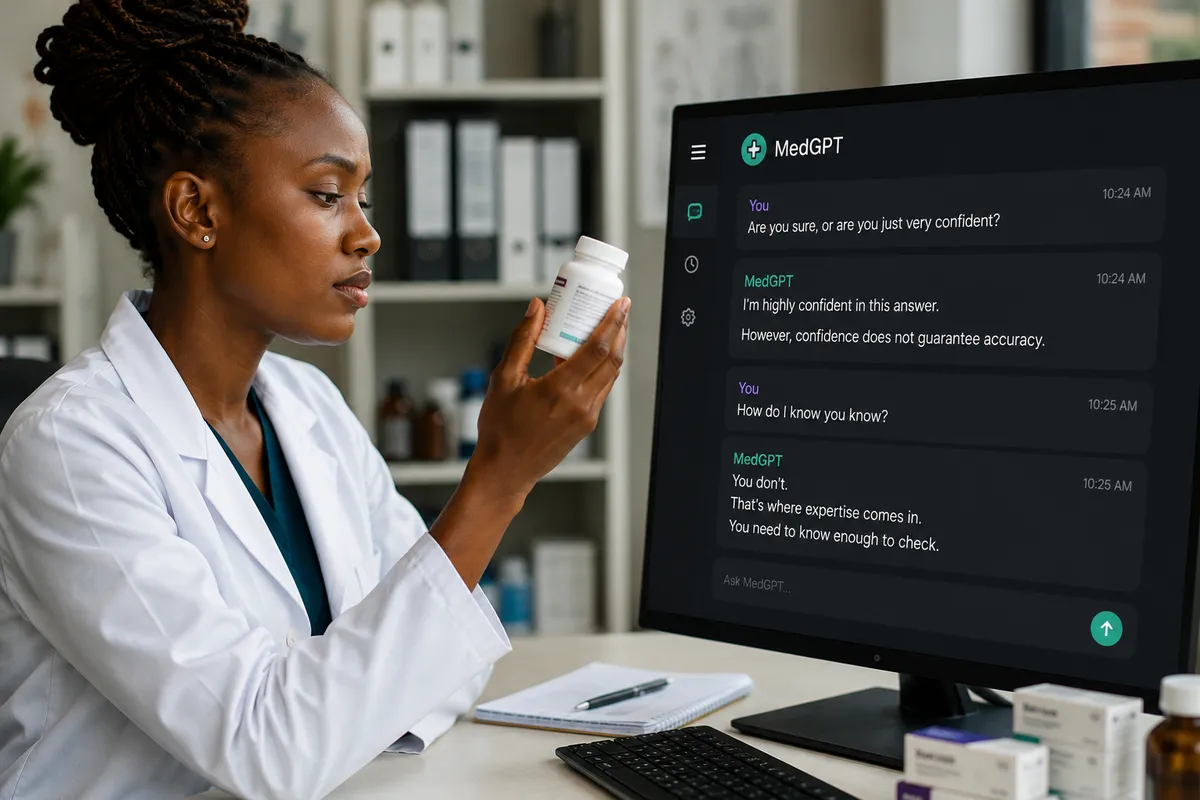
AI Doesn't Replace Expertise. It Tests It.

AI can make work faster, but it cannot replace the expertise needed to judge whether its answers are correct. As AI becomes more embedded in life sciences, professionals need deep industry knowledge to question, verify and apply its outputs effectively. The real advantage is not simply knowing how to use AI, it is knowing when to trust it.
A strange assumption sits underneath a lot of the conversation about AI and careers: that as AI gets better, knowing less about your profession will matter less.
After all, if AI can explain a regulation, summarize a clinical trial, analyze a safety report or build a supply chain forecast in seconds, why spend years learning all the technical details yourself?
Because there is a difference between getting an answer and knowing whether the answer makes sense.
And that difference is becoming harder to ignore.
The World Economic Forum’s Future of Jobs Report 20251 found that 39% of workers’ key skills are expected to change by 2030. The skills gap is already the biggest barrier to business transformation, cited by 63% of employers, while 77% of employers say they plan to up-skill their workforce in response to AI. At the same time, 41% expect to reduce their workforce where AI can automate certain tasks.
That tells us something important.
The future of work is not simply asking people to learn AI. It is asking people to keep learning. And that includes understanding the work AI is being brought in to do.
Kenya seems to be making the same bet.
The Kenya AI Strategy 2025–20302 places AI digital infrastructure, data and AI governance, and AI research, innovation and commercialization at the center of the country's AI agenda. The strategy is not simply about putting AI tools into people's hands. It is about building the infrastructure, governance, and human capacity needed to develop and use AI effectively.
The African Union’s Continental AI Strategy3 takes a similar Africa-centric approach, positioning human capital, research, innovation and responsible AI as part of the continent’s broader development agenda.
So yes, we need people who understand AI.
But we also need people who understand the industries into which AI is being introduced.
That distinction matters enormously in life sciences.
Take regulatory affairs.
You can ask an AI system to explain the requirements for registering a pharmaceutical product in a particular market and, within seconds, receive something that looks remarkably professional. It may have the right terminology, neatly organized sections, and enough regulatory language to sound convincing.
But regulatory work is not simply knowing what a regulation says.
It is knowing which regulation applies, which pathway the product falls under, whether the information is current, what assumptions have been made, and where the answer needs to be verified.
A person with domain knowledge can interrogate the output.
A person without it may not even know there is something to interrogate.
And we now have evidence showing why that matters.
A 2026 study published in the Proceedings of the AAAI Conference on Artificial Intelligence4 tested leading large language models on 4,695 complex medical cases, using 20,288 evaluation criteria and validation from 60 licensed physicians. Even the best-performing model recorded a hallucination rate of 29.1%, while some models exceeded 57%.
The point is not that AI is useless.
It is that an answer can look convincing and still be wrong.
The World Health Organization’s guidance on large multmodal models5 makes a similar warning. WHO identifies the risk of false, inaccurate, biased or incomplete outputs and specifically highlights automation bias — where people overlook errors because they place too much confidence in an AI system.
That creates an interesting problem for professionals.
What happens when the person using AI does not have enough technical knowledge to recognize the mistake?
In pharmacovigilance, AI can help process and organize large volumes of safety information. But identifying a pattern is not the same as knowing whether it represents a meaningful safety signal, whether further investigation is required, or what the regulatory implications might be.
In medical affairs, AI can summarize clinical study data in minutes. But a summary is not clinical evidence. Turning study findings into evidence that healthcare professionals, key opinion leaders, payers, and care designers can understand and act on requires more than speed. It requires Medical Affairs judgment: the ability to interpret study design, test the validity of findings, identify limitations, assess clinical relevance, and package the evidence in a way that is scientifically credible and decision-ready.
In pharmaceutical supply chain management, AI can forecast demand, identify inefficiencies, and model different inventory scenarios. But pharmaceutical supply chains have their own realities around procurement, quality, distribution, stock availability and regulatory requirements. A technically impressive forecast does not automatically become a good supply chain decision unless inferences are made based on day-to-day operational nuances that AI tools may never know about.
And in product management, AI can produce a market analysis, customer persona or product strategy before you have finished your coffee.But if you do not understand the customer or the market, you can end up with something far more dangerous than an obviously bad strategy. In this context, the greatest risk especially in Africa is the over-generalization of markets with limited to no data in a structured and accessible manner. AI therefore relies on over-analyzed public reports or anecdotal evidence without a validated basis to generate a business case and strategy.
You can get a very convincing one.
This is where I think the conversation about AI and careers needs to change.
There is a lot of advice telling professionals to become "AI literate." Learn prompting. Learn automation. Learn how to integrate AI into your workflow.
Fair enough.
But there is another question underneath it:
What exactly are you bringing to the workflow?
Because if two professionals are given the same AI tool, the advantage will not necessarily belong to the person who knows the cleverest prompt.
It may belong to the person who understands the field well enough to challenge the answer.
The one who knows what information is missing.
The one who knows which source to check.
The one who recognizes that the assumptions behind the answer do not fit the situation.
The one who understands what happens if the decision is wrong.
That is domain expertise.
And AI is not making it obsolete.
It may actually be making it easier to see who has it.
For years, professional development was partly about helping people acquire information they could then apply in their work. AI is changing that equation. Information is becoming incredibly cheap. You can ask a machine to explain a concept, summarize a regulation or compare two approaches almost instantly.
But knowing something and understanding how it operates in the real world are not the same thing.
And that distinction matters even more in life sciences, where a wrong interpretation can have consequences far beyond a bad report.
This is why technical knowledge remains an important part of professional development. This understanding is at the core of our work with African Pharmaceutical Network (APN) especially in our training programs where we focus on building technical understanding of the industry, correlating technical insights with operational nuances and challenging professionals to apply these in real world cases with the freedom to leverage on AI technologies in a controlled setting i.e., we review, challenge and give feedback for optimal performance.
This is not because AI is going away.
Quite the opposite.
Because it isn't.
AI will continue to get better at finding information, generating content, analyzing data and supporting decisions. The professionals who benefit most from it will be those who can use that capability without surrendering their own judgment.
AI can make the work faster. It cannot make poor understanding less consequential.
So perhaps the advice to professionals should not simply be:
"Learn AI or get left behind."
Perhaps it should be:
Learn AI. But learn your industry deeply enough to know when not to trust it.
Because when everyone has access to the same AI, the advantage may no longer be who can get an answer fastest.
It may be who knows what to do with it.
And perhaps the harder question is:
If AI can make almost anyone sound like an expert, what will distinguish the people who actually are?
REFERENCES
Future of Jobs Report 2025: 78 Million New Job Opportunities by 2030 but Urgent Upskilling Needed to Prepare Workforces:
Kenya AI Strategy 2025 – 2030: https://www.ict.go.ke/sites/default/files/2025-03/Kenya%20AI%20Strategy%202025%20-%202030.pdf
Continental Artificial Intelligence Strategy: https://au.int/en/documents/20240809/continental-artificial-intelligence-strategy
Proceedings of the AAAI Conference on Artificial Intelligence: https://ojs.aaai.org/index.php/AAAI/article/view/41243
WHO releases AI ethics and governance guidance for large multimodal models: https://www.who.int/tokelau/news/detail-global/18-01-2024-who-releases-ai-ethics-and-governance-guidance-for-large-multi-modal-models